
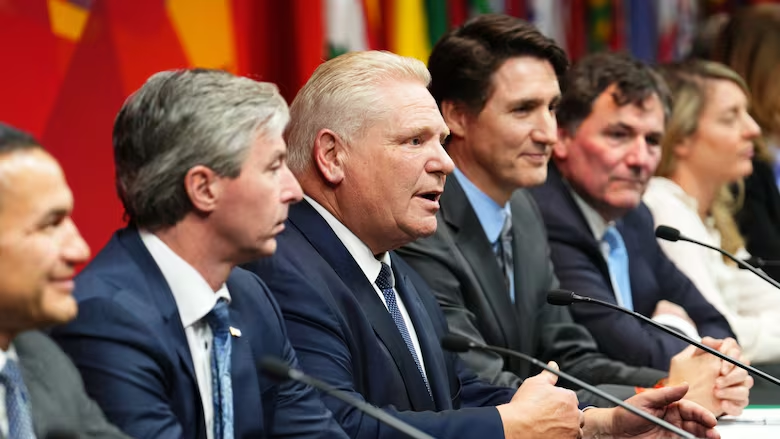
As Canada braces for the possibility of a trade war with the United States, the nation’s leaders are turning their focus inward, advocating for the removal of interprovincial trade barriers to bolster the economy. Prime Minister Justin Trudeau and provincial premiers held a virtual meeting this week, during which they reached a consensus that more action is needed to streamline internal trade. Federal Internal Trade Minister Anita Anand highlighted the potential benefits, including lowering consumer prices by up to 15%, boosting productivity by 7%, and injecting up to $200 billion into the domestic economy.
The longstanding barriers, however, are deeply entrenched in Canada’s history and regulatory framework. A 2019 International Monetary Fund report identified various obstacles, such as prohibitive restrictions on alcohol sales, technical differences in vehicle standards, and regulatory requirements for licensing. Perrin Beatty, CEO of the Canadian Chamber of Commerce, described these barriers as “invisible to most Canadians” yet profoundly impactful on commerce and mobility. Ontario Premier Doug Ford echoed this frustration, labeling the inconsistencies in rules across provinces “ridiculous” and calling for immediate reform.
Despite previous efforts like the 2017 Canadian Free Trade Agreement (CFTA), progress has been limited due to exemptions and provincial resistance. A 2023 report from the Montreal Economic Institute revealed 245 exemptions still in place, with Quebec alone accounting for 35. Former Quebec Premier Philippe Couillard explained that entrenched cultural and economic interests, such as the province’s French language laws and reliance on Crown corporations, complicate reform efforts. “Politically, it would create significant turmoil,” Couillard noted, reflecting the delicate balance between economic integration and local autonomy.
Some experts propose that provinces model their reforms on the New West Partnership Trade Agreement (NWPTA), which has successfully harmonized regulations across British Columbia, Alberta, Saskatchewan, and Manitoba. Carlo Dade of the Canada West Foundation argued that expanding the NWPTA framework could serve as a pragmatic solution. “Having the agreement in place changes the dynamics of negotiation,” Dade said, emphasizing the need for a unified approach to tackle internal barriers.
As the threat of U.S. tariffs looms, Canada faces a critical moment to address its internal inefficiencies. Beatty suggested that external pressures, such as the policies of former U.S. President Donald Trump, might ironically catalyze domestic reform. “Trump may force jurisdictions in Canada to say, ‘What can we do to make ourselves more efficient domestically?'” Beatty remarked. With billions at stake, Canada’s leaders may finally find the political will to break down barriers and strengthen the country’s economic resilience.
